
INDEPENDENT LAB RESULTS
A lot of mattresses claim to sleep cool. We had ours independently tested in a lab so we don’t have to just say it — we can show you exactly what the results mean for your sleep.
It wicks moisture away
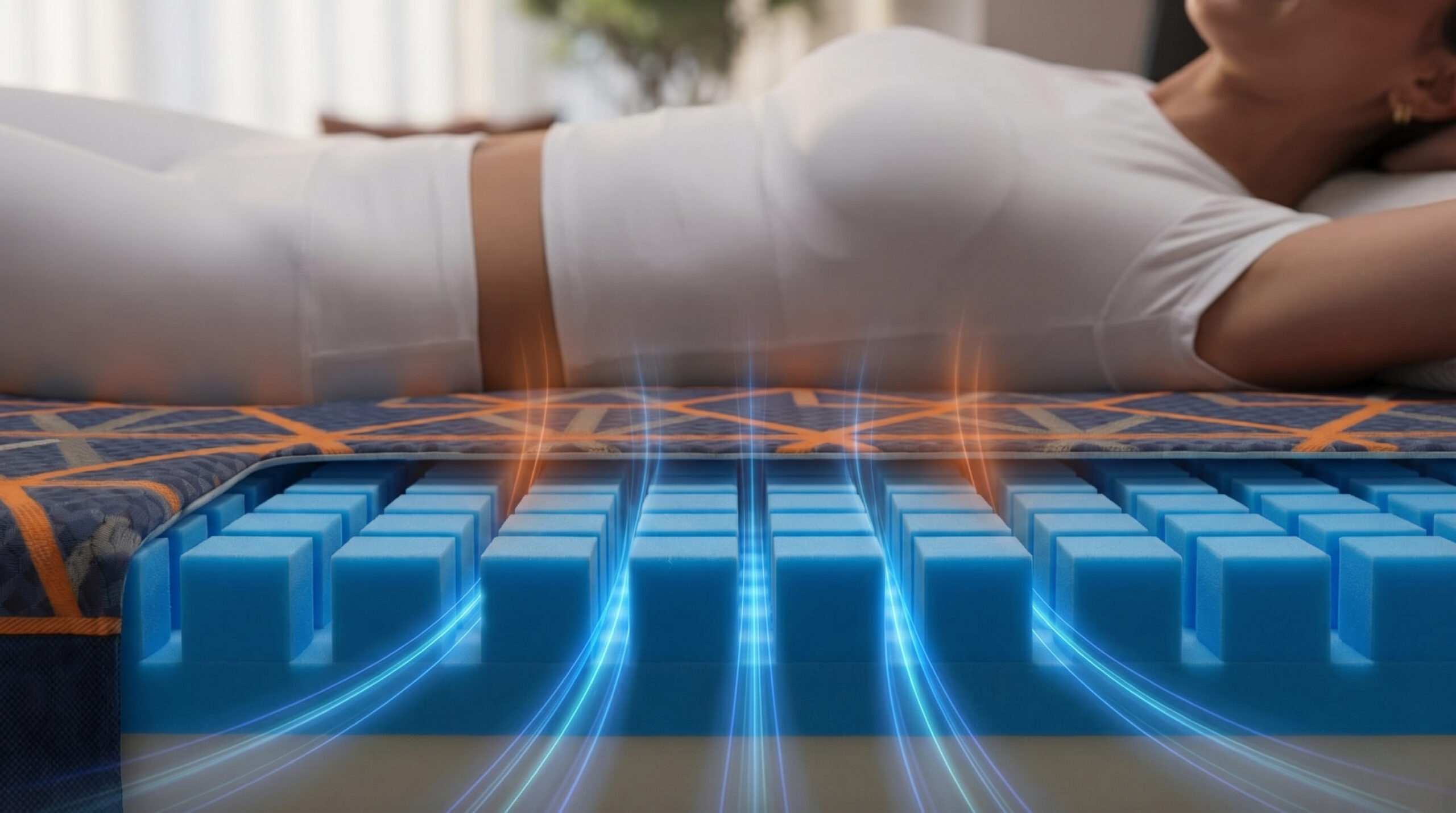
When you sweat during sleep, the Qube GelShell® actively moves that moisture away from your body instead of letting it sit between you and the mattress — keeping the surface feeling dry.
14.11 g of moisture moved per m² per hour
It cools down faster when you move
Every time you shift position or get out of bed, the Qube GelShell® quickly releases the heat that built up beneath you — so you're not rolling into a warm spot.
Surface drops ~3°C within seconds of pressure being lifted
It breathes throughout the night
The Qube GelShell® allows air and vapor to pass through the mattress continuously — meaning heat and humidity don't build up over time the way they do in denser foam mattresses.
Consistent surface temperature across a full 3-hour test
WHAT THE TESTS ACTUALLY MEASURED
How did they test moisture wicking?
A heated plate — designed to mimic the heat and sweat your body produces — was placed on the mattress under controlled conditions. The lab measured how much of that moisture the mattress was able to move away from the surface per hour. The Qube moved 14.11 grams of moisture per square meter per hour. For comparison, a typical memory foam mattress tested in the same conditions moved just 4.67 g — less than a third as much.
How did they test heat recovery?
A body-shaped fixture — heated to body temperature and loaded with moisture to simulate a sleeping person — was placed on the mattress for three hours. At the end of each trial it was briefly lifted and put back down. The lab measured how quickly the mattress shed the built-up heat in those seconds. The Qube averaged a recovery score of 382 — the higher the number, the faster the cool-down.
Does the mattress stay cool over time or just at first?
The body analog test ran for 180 minutes continuously — roughly equivalent to a few hours of sleep. Surface temperature stayed stable the entire time, measuring 36.0°C at 60 minutes and just 36.3°C at 180 minutes. That’s a difference of less than half a degree over three hours, which tells you the Qube isn’t slowly heating up as the night goes on.
"The Qube moved more than 3× the moisture per hour compared to memory foam tested under the same independent lab conditions."
WHO DID THE TESTING?
All testing was carried out by Element Materials Technology, an independent, accredited testing laboratory. They used ANSI/RESNA SS-1:2019 — the industry standard for measuring how mattresses handle heat and moisture. We submitted the mattress, they ran the tests, and the results are theirs — not ours.
Testing conducted on Qube / Qube-1402, Queen size. Report number ESP044654P.3.R0, Element Materials Technology, St. Paul, MN. Results pertain only to the unit submitted for testing. Memory foam comparison data from the same test batch under identical conditions. Full report available upon request.